
AIDSVu presents ZIP Code-level data on HIV for 60 cities, representing over half of all new HIV diagnoses nationwide
ATLANTA, GA (November 13, 2025) — AIDSVu, the nation’s leading interactive resource for visualizing the HIV epidemic, today announced the addition of new and updated city-level HIV data and maps across 60 U.S. cities down to the ZIP Code view, continuing to show how the epidemic affects communities at the local level.
This year AIDSVu adds El Paso, Texas, and Riverside County, California to the map for the first time. With this update, AIDSVu now provides detailed ZIP Code-level data for 60 cities, representing over half of all new HIV diagnoses nationwide. The city view on AIDSVu shows HIV prevalence, new diagnoses, demographics, and HIV care outcomes, enabling users to explore interactive maps, generate visualizations, and download data to support local planning. See below for a list of the 60 cities with data available on AIDSVu.
“Local data tell the real story of the HIV epidemic in America,” said Dr. Patrick Sullivan, Principal Scientist of AIDSVu and Professor of Epidemiology at Emory University’s Rollins School of Public Health. “By making detailed, ZIP Code-level data accessible and visual, we’re giving public-health leaders, policymakers, and communities the insights they need to direct resources to the communities and areas that are most impacted and measure progress toward ending the epidemic.”
Connecting Local Insights to a National Picture
AIDSVu works directly with city health departments and each year we add new cities to further fill in the picture of HIV in the United States. The 2025 city-level data expansion strengthens AIDSVu’s mission to make HIV data widely accessible, comparable, and actionable for community organizations, researchers, and policymakers. Some facts about the cities with data available on AIDSVu include:
- These 60 cities include 23 of the 25 most populous cities in the U.S.
- These cities represent every major U.S. region — South, Northeast, Midwest, and West — plus Puerto Rico, making it nearly a full map of America’s most significant population centers.
- Together, these 60 cities account for over 70% of U.S. GDP.
- New York City, Los Angeles, San Francisco, Washington DC, Atlanta, Chicago, and Miami are consistently ranked among the top 10 U.S. metros for LGBTQ population density and visibility.
- Most of these cities host Ryan White Part A–funded programs, meaning they receive federal grants for HIV care coordination, medication access, and community support.
- 17 of the 20 Centers for AIDS Research (CFAR) are in cities mapped on AIDSVu.
- Washington, DC, state capitals like Boston, Austin, Raleigh, Nashville, and Denver, and large regional centers like Phoenix and Atlanta all represented on AIDSVu are key for both political organizing and policy advocacy. Together, these metros represent the majority of the U.S. congressional delegation’s home districts, making them critical for coalition outreach or national advocacy efforts.
“Understanding where and why disparities persist is the foundation for equitable health policy,” said Dr. Sullivan. “Each city’s data not only tells a local story — it contributes to a national understanding of progress and the work still ahead.”
Four Cities, Four Stories: Local Data Driving National Impact
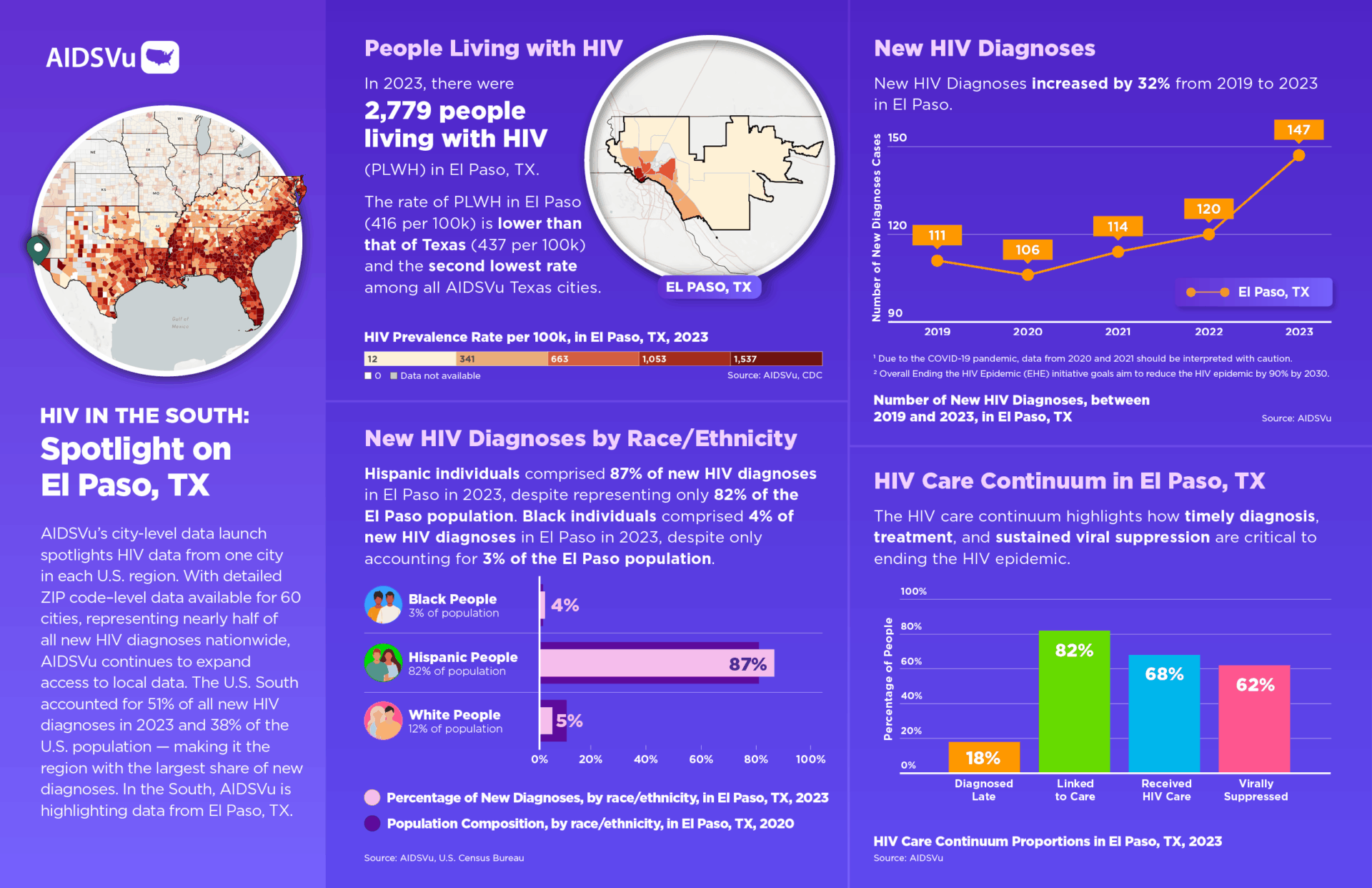
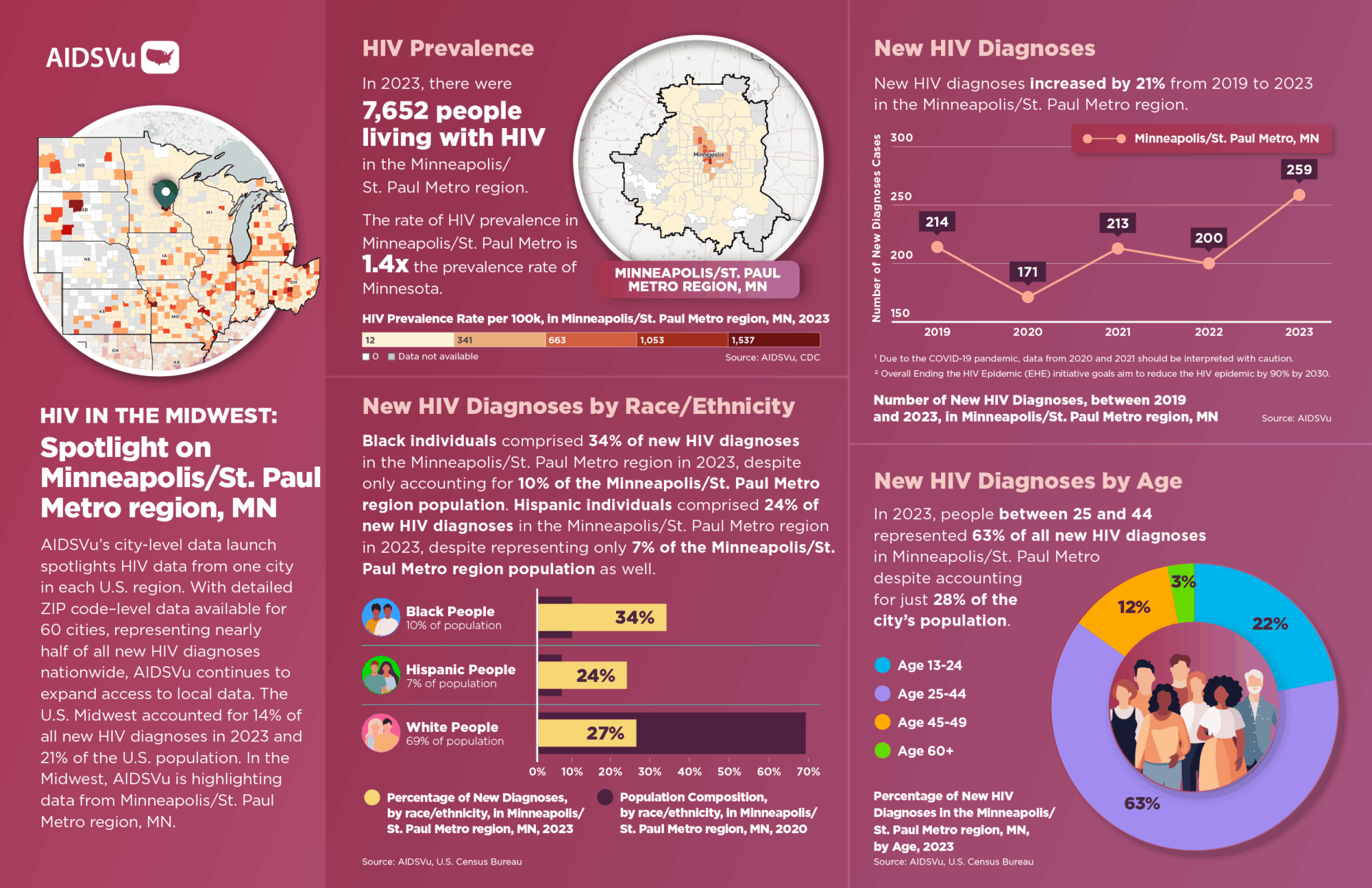
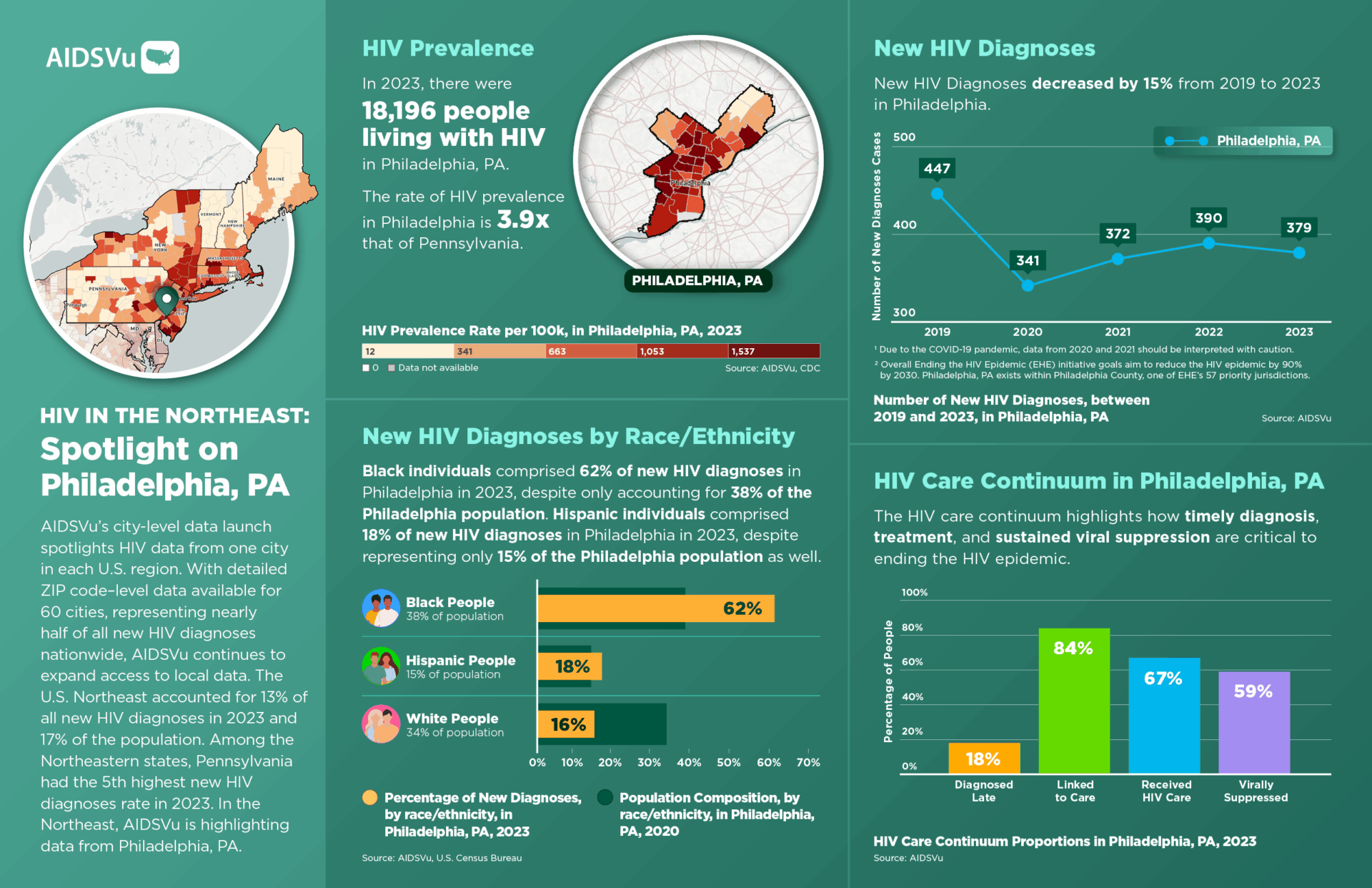
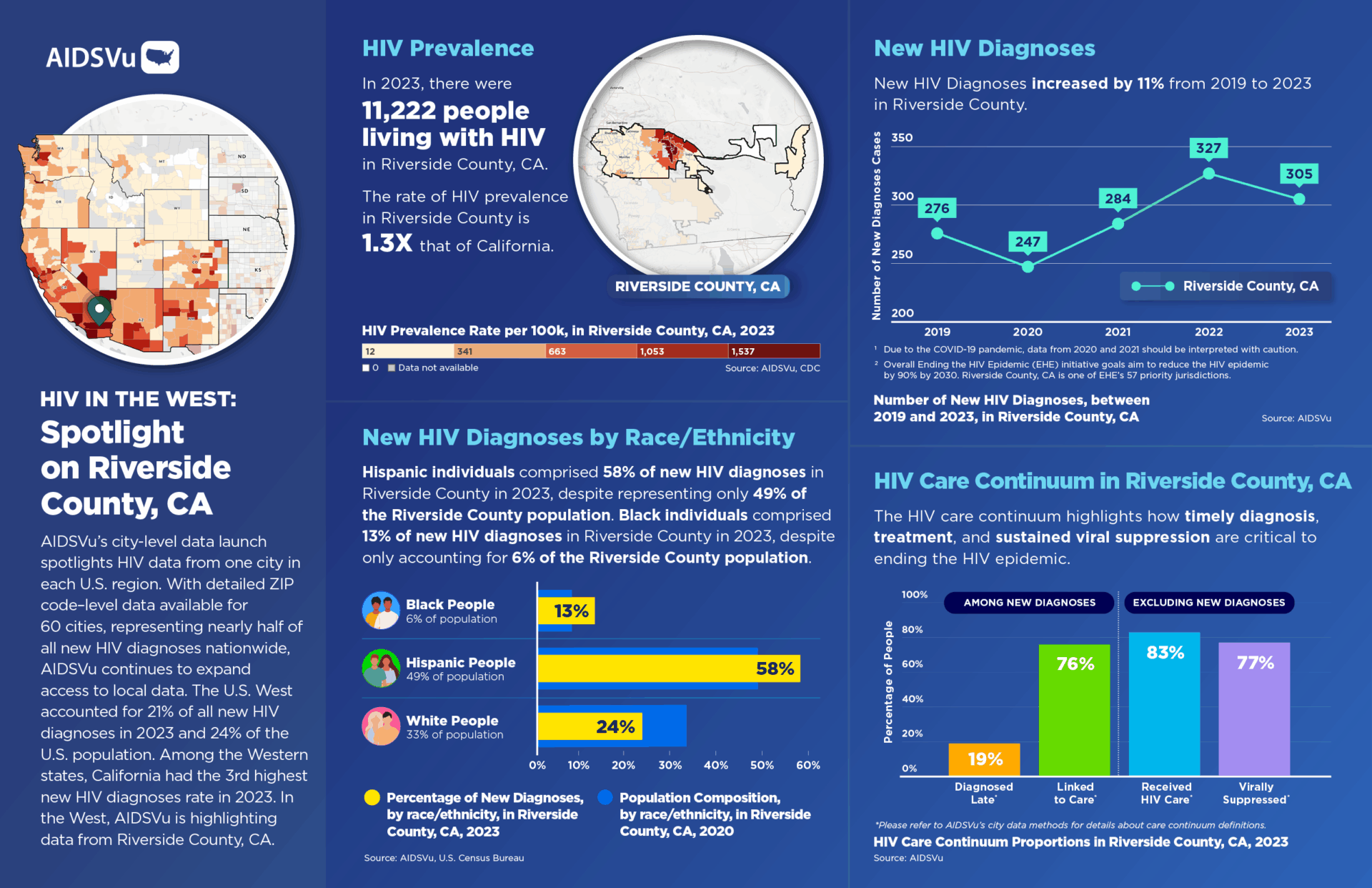
As part of this year’s data launch, AIDSVu has developed data insights and infographics for El Paso, Texas, Riverside County, California, Philadelphia, Pennsylvania, and the Minneapolis–St. Paul Metro Area, Minnesota. Together, these cities represent a cross-section of the U.S. epidemic, from border regions and western suburbs to major northeastern and midwestern metros, illustrating how geography, race, and access to care continue to shape health outcomes.
- El Paso, Texas – New data reveal a 32% rise in new HIV diagnoses from 2019 to 2023, with 88% of new cases among Hispanic residents. While El Paso maintains one of the lowest HIV prevalence rates among Texas metros (416 per 100K people), the increase underscores the need for prevention and care access across border communities.
- Riverside County, California – Home to more than 11,000 people living with HIV, Riverside’s prevalence rate (538 per 100K people) is 1.3× higher than the statewide average. Hispanic residents accounted for nearly 58% of new diagnoses, highlighting ongoing disparities in one of California’s fastest-growing regions.
- Philadelphia, Pennsylvania – Despite a 15% decline in new diagnoses since 2019, Philadelphia continues to experience sharp racial disparities, with 62% of new cases among Black residents. Nearly 60% of people living with HIV are virally suppressed, showing progress but also the need for continued investment in equitable care.
- Minneapolis–St. Paul Metro, Minnesota – New diagnoses increased 21% between 2019 and 2023, with 34% of new cases among Black residents in a metro area that is only 10% Black. The trend highlights the importance of addressing racial inequities and supporting prevention in suburban and emerging-risk communities.
Major City-Level Data Updates Include:
- ZIP Code-level maps showing HIV prevalence (2023) and new diagnoses (cumulative 2019-2023) for 57 U.S. cities (2022 for 3 cities)
- ZIP Code-level maps showing HIV care continuum indicators in 2023, such as linkage to care, late HIV diagnoses, receipt of care, and viral suppression for 50 U.S. cities.
- Updated and more accessible city-level location profiles that can be downloaded as city-specific factsheets.
- ZIP Code-level maps exhibiting social determinants of health – including poverty, education, median household income, income inequality, and housing cost burden.
- Interactive service locators, including HIV testing, PrEP, HIV care, stigma reduction, overdose prevention/reversal, harm reduction and trauma-informed care.
Cities Available on AIDSVu:
Birmingham, AL, Mobile, AL, Montgomery, AL, Phoenix, AZ, Los Angeles County, CA, Orange County, CA, Oakland/Alameda County, CA, Riverside County, CA, San Diego, CA, San Francisco, CA Denver, CO, Bridgeport, CT, Hartford, CT, New Haven, CT, Washington, DC, Fort Lauderdale, FL, Jacksonville, FL, Miami, FL, Orlando, FL, Tampa, FL, West Palm Beach, FL, Atlanta, GA, Chicago, IL, Baton Rouge, LA, New Orleans, LA, Baltimore, MD, Boston, MA, Detroit, MI, Minneapolis, MN, Jackson, MS, Kansas City, MO, St. Louis, MO, Las Vegas, NV, Jersey City, NJ, Newark, NJ, New York City, NY, Charlotte, NC, Raleigh, NC, Cincinnati, OH, Cleveland, OH, Columbus, OH, Oklahoma City, OK, Tulsa, OK, Philadelphia, PA, San Juan, PR, Providence, RI, Charleston, SC, Columbia, SC, Memphis, TN, Nashville, TN, Austin, TX, Dallas, TX, El Paso, TX, Fort Worth, TX, Houston, TX, San Antonio, TX, Hampton Roads, VA, Richmond, VA, Seattle, WA, Milwaukee, WI.
About AIDSVu’s Annual City Data Update:
AIDSVu is presented by Emory University’s Rollins School of Public Health in partnership with Gilead Sciences, Inc. and the Center for AIDS Research at Emory University (CFAR). AIDSVu continues to advance its mission to make HIV data widely available, easily accessible, and locally relevant to inform public health decision-making. The site aims to provide researchers, policymakers, and community members with a more comprehensive understanding of the HIV epidemic at the local-, state-, and national-level.
ZIP Code-level data were provided by state and city health departments and compiled by researchers at the Rollins School of Public Health. Learn more about AIDSVu’s HIV care continuum data and sources, see our FAQ and Data Methods.