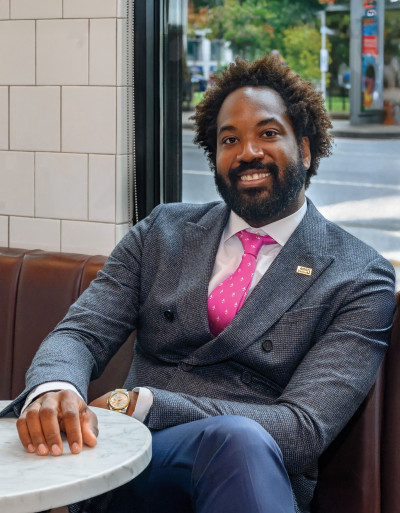
Carl Baloney Jr. is President and CEO at AIDS United, where he has spent the past decade working at the intersection of federal HIV policy and philanthropy. His work focuses on translating the lived realities of Black communities into national policy priorities while ensuring that grantmaking supports community-driven solutions. Baloney is a leading voice for equity, accountability, and community leadership in the fight to end the HIV epidemic.
Q: You’ve spent nearly a decade shaping federal HIV policy and philanthropy at AIDS United. How did you get into this space and what lessons from national advocacy and grantmaking do you see as most important for improving outcomes in Black communities at the local level?
I came into this work early in my career, when it became clear how policy decisions made far from our neighborhoods directly shape who lives, who gets care, and who is left behind. My path at AIDS United has focused on translating the lived realities of Black communities into federal policy priorities and ensuring that philanthropy reinforces those same goals rather than operating in isolation.
The most important lesson I’ve learned is that national strategy only works when it is rooted in local leadership. Funding that is flexible, multi-year, and community-driven consistently outperforms short-term, top-down initiatives. When Black-led organizations are trusted to define solutions, build infrastructure, and advocate for policy change, outcomes improve because interventions reflect culture, history, and real community need.
Q: National Black HIV/AIDS Awareness Day is a time to reflect on where we are in the fight against HIV. Despite making up only 12% of the U.S. population, Black Americans accounted for 38% of new HIV diagnoses in 2023. When you look at the current HIV landscape in Black communities across the U.S., what stands out most, and what does this moment reveal about where efforts are succeeding or falling short in ending the HIV epidemic?
What stands out most is that the science is ahead of the system. We have the tools to prevent HIV and support long, healthy lives, yet Black communities are not benefiting from them at the same rate as others.
Where we are succeeding is innovation. Across the country, we see new PrEP delivery models, community-based testing, and peer navigation programs working in pockets. Where we are falling short is scale and equity. Structural barriers—fragmented healthcare systems, unstable housing, workforce shortages, and persistent racism—continue to block access. The data make clear that ending the epidemic is not just a biomedical challenge; it is a justice challenge.
Q: Many Black communities face overlapping challenges such as stigma, housing instability, limited access to healthcare, and economic pressures. For example, in 2023, Black Americans had the highest HIV-related Stigma score at 30.4 and the lowest viral suppression rate at 63.5%, indicating discrimination based on race/ethnicity and/or HIV status may delay adequate HIV treatment. How have you seen these factors intersect with HIV prevention and care efforts on the ground?
These challenges are not parallel, they are cumulative. I’ve seen people who are ready to start treatment or PrEP but cannot keep appointments because they are unhoused, working multiple jobs, or navigating systems that do not respect their dignity.
Stigma remains one of the most powerful barriers. It delays testing, disrupts adherence, and isolates people from care. When stigma intersects with poverty, criminalization, and housing instability, it creates a cycle that undermines even the strongest clinical interventions. Programs that address HIV in isolation, without confronting these realities, will always fall short.
Q: Community leadership has long been a driving force in the HIV response. Based on your experience working with local and Black-led organizations, what does meaningful community leadership look like, and why is it essential to sustaining progress?
Meaningful community leadership is not symbolic. It means people most impacted by HIV are setting priorities, shaping programs, and holding systems accountable. It looks like Black-led organizations running policy campaigns, managing large-scale programs, and being resourced to plan beyond the next grant cycle.
This leadership is essential because it builds trust. It ensures interventions are culturally relevant, trauma-informed, and responsive to emerging needs. Most importantly, it creates durability. Movements are not sustained through pilot projects, they are sustained through institutions rooted in community.
Q: Looking ahead, what gives you the most hope in the HIV response in Black communities, and how can policymakers, funders, and public health leaders build on that progress to strengthen impact moving forward?
What gives me hope is the clarity and power of Black community organizing today. Across the country, Black advocates are demanding accountability around PrEP access, Medicaid expansion, harm reduction, and housing. There is also a new generation of leaders who are unapologetically linking HIV to racial and economic justice.
To build on this momentum, policymakers and funders must align investments with community priorities. That means protecting and expanding federal HIV funding, funding Black-led organizations directly, investing in workforce development, and embedding equity into every major public health initiative. Progress will not come from new slogans, it will come from sustained investment.
Q: Finally, what message would you want Black communities to hear this NBHAAD about HIV, health, and the importance of staying engaged in the fight against the epidemic?
My message is simple: you matter, your health matters, and your leadership matters. HIV is not a failure of our communities, it is the result of systems that have too often failed us. Staying engaged, whether through testing, supporting local organizations, or advocating for policy change, is how we protect one another.
Ending the epidemic in Black communities is possible. It requires collective action, honesty about what is not working, and a refusal to accept inequity as inevitable. This day is not just about awareness, it is about power.