
National Latinx AIDS Awareness Day (NLAAD) is observed each year on October 15 to raise awareness about the impact of HIV on Hispanic/Latinx communities in the United States. This year’s theme underscores both progress and persistent inequities: while HIV prevention and care outcomes have improved overall, Hispanic/Latinx communities continue to face disproportionate burdens and barriers to access.
Key Facts
-
In 2023, there were 39,182 new HIV diagnoses in the U.S. Hispanic/Latinx people accounted for 32% of new HIV diagnoses, despite making up only ~19% of the U.S. population.
-
Among Hispanic/Latinx individuals diagnosed with HIV (2022 data, most recent available by transmission category):
-
77% were attributed to male-to-male sexual contact
-
16% to heterosexual contact
-
-
In 2023, care continuum outcomes showed that among Hispanic/Latinx individuals,
-
85% of newly diagnosed individuals were linked to care
-
74% of people living with diagnosed HIV received care
-
66% achieved viral suppression
-
PrEP Use and Disparities
-
PrEP use is growing: Between 2022 and 2023, the number of PrEP users overall increased by 17% nationwide.
-
In 2024, more than 591,000 people were using PrEP, with a national PrEP-to-Need Ratio (PnR) of 15.6 (about 16 PrEP users for every new HIV diagnosis). Hispanic/Latinx individuals, however, had a PnR of 7.4 (about 7 PrEP users for every new HIV diagnosis).
-
Disparities persist:
-
In 2023, Hispanic/Latinx people represented 31% of new HIV diagnoses but only 18% of PrEP users.
-
Black people accounted for 39% of new diagnoses but just 14% of PrEP users.
-
White people made up 24% of new diagnoses but 64% of PrEP users.
-
-
Regional inequities: In 2023, Hispanic/Latinx people accounted for 29% of new HIV diagnoses in the South, but only 19% of PrEP users (2024) in the South were Hispanic/Latinx.
Social Determinants of Health
HIV prevention and care outcomes in Hispanic/Latinx communities are shaped by broader social and structural factors, including:
-
Access to healthcare: Lack of insurance, language barriers, and limited culturally competent care providers restrict access to prevention and treatment.
-
Economic barriers: Higher rates of poverty, unstable housing, and employment insecurity can disrupt consistent HIV care.
-
Immigration and stigma: Fear of disclosing HIV status, immigration concerns, and stigma around both HIV and sexual orientation can prevent individuals from seeking care.
-
Geography: Many Hispanic/Latinx individuals live in the South, where HIV rates are highest and prevention resources are most limited.
National Latinx AIDS Awareness Day 2025 is a reminder that addressing HIV inequities requires sustained investment and culturally tailored strategies. To advance equity, we must:
-
Expand access to HIV testing, PrEP, and treatment in Hispanic/Latinx communities.
-
Address stigma and build trust through culturally appropriate outreach.
-
Ensure equitable distribution of resources across regions, particularly in the South.
-
Strengthen policies that reduce barriers to healthcare and support community-led initiatives.
Together, these steps can help close the gap in HIV outcomes and ensure Hispanic/Latinx communities are central to the effort to end the epidemic.
“Start Treatment. Stick to It. Get Better.”
Explore our Resources
AIDSVu’s infographics encourage new ways of visualizing the HIV epidemic among Hispanic/Latinx/Latine communities. Share them on social, print them out as one-pagers, and add them to your presentations.
Infographic
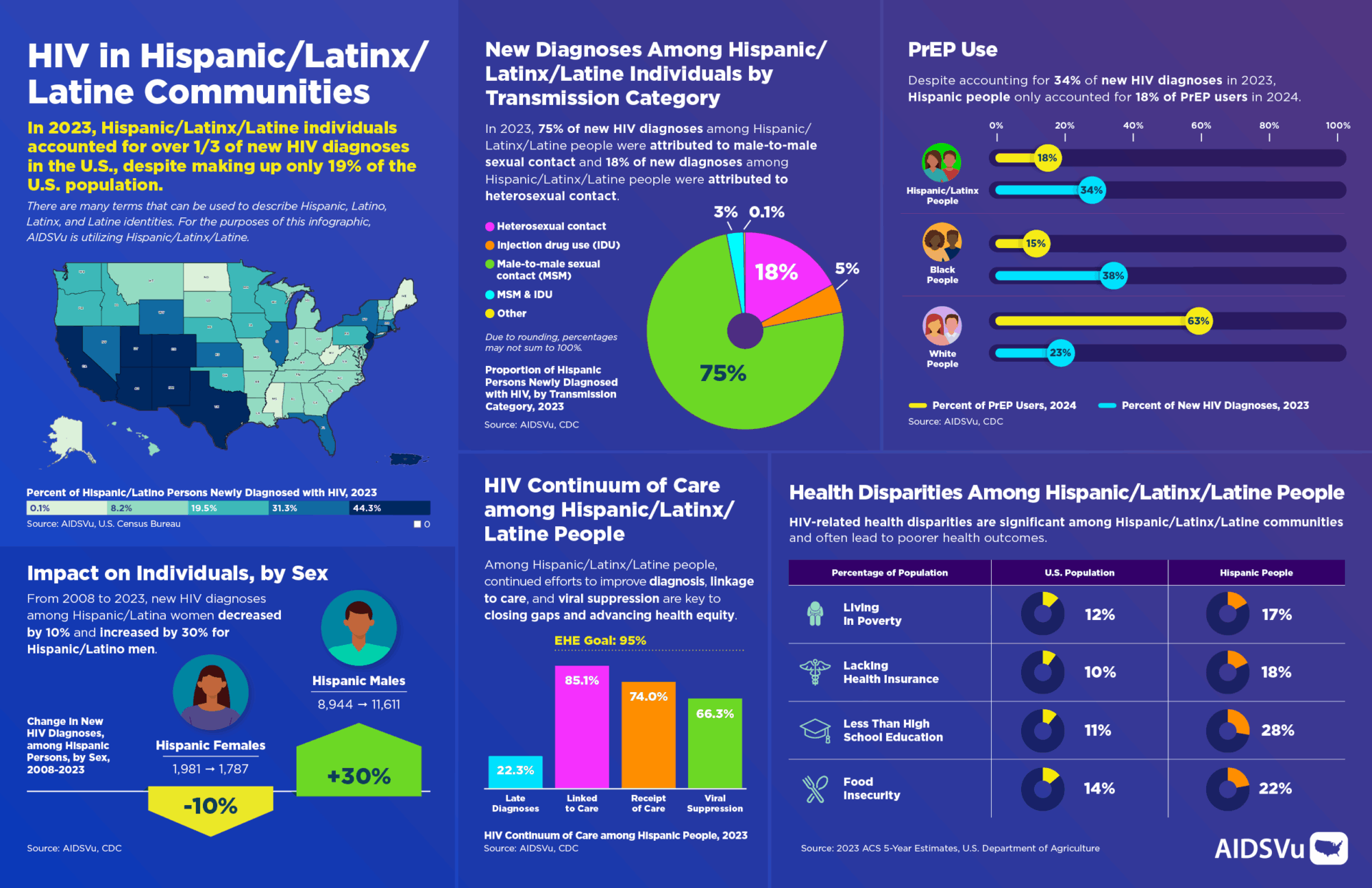
Update your LinkedIn, Facebook, and X banners to show your support for #NLAAD.
Facebook/LinkedIn
Twitter/X




Share these social media posts and infographics on LinkedIn, X, and Facebook with #NLAAD to help spark conversations about HIV among Hispanic/Latinx/Latine communities.
Post 1
📅 Today is National Latinx AIDS Awareness Day.
Hispanic/Latinx people made up 32% of new HIV diagnoses in 2023 but only 18% of PrEP users.
It’s time to close the gap.
#NLAAD #StopHIVTogether
Post 2
HIV prevention works — but not for everyone equally.
In 2024, more than 591,000 people were on PrEP, yet Hispanic/Latinx communities remain underrepresented.
This #NLAAD, let’s work toward equity in access, care, and prevention.
Post 3
Hispanic/Latinx communities continue to face disproportionate HIV impacts due to barriers like stigma, access to care, and poverty.
On #NLAAD, we honor resilience — and commit to ending inequities.
Together, we can #StopHIVTogether.